Optics 1/Fundamental Optics Principles Present
ContentsIntroductionPoint Sources & VergenceCollimationReflectionRefractionApplicationsLenses & Focal PointsWrap-up
Handout PDF Worksheet
Optics 1 · Lecture 1

Fundamental Optics Principles

Vergence, reflection, refraction, and lenses · Dr. Michael J. Collins

F′
Follow along: Lecture handout (PDF) Practice worksheet (PDF)
Introduction

Learning Objectives

Today we will discuss the following principles, and solve problems related to each.

Point Sources & Vergence

Point Sources of Light

  • If we imagine a small, powerful source of light, we get the physical idealization of a point source.
  • Light leaves a point source equally in every direction.
  • We can describe that light two ways: as rays streaming outward, or as wavefronts rippling outward.
Point source emitting rays and circular wavefrontsraywavefrontpoint source
Show light as
An idealized point source sends light out equally in every direction. Rays show the direction light travels; wavefronts are the ripples, always perpendicular to the rays.
Point Sources & Vergence

Divergence

  • From a point source, light diverges: rays stream outward, like light from the sun, while waves ripple outward.
  • The farther the light travels, the larger and flatter its wavefronts become.
Light diverging from a point sourcepoint sourceDiverging → negative vergence (−D)
Light is
Light spreading away from a point is diverging. Its wavefronts bulge forward and grow flatter as they travel.
Point Sources & Vergence

Convergence

  • Using lenses or other means, light can be condensed to focus back onto a point. This is the meaning of convergence.
  • Converging wavefronts shrink as they close in on the focal point.
Light converging through a lens to a focal pointconverging lensfocal pointConverging → positive vergence (+D)
Light is
A converging (plus) lens bends parallel rays toward a single point. The wavefronts after the lens curve inward and shrink into the focal point.
Point Sources & Vergence

Measuring Divergence

  • Sometimes we need to know how far light has diverged from its source.
  • Taking the reciprocal of the distance (in meters) from the source to the observer gives a unit called the diopter (D).
  • By convention, divergence is negative and convergence is positive.
  • Example: a source 4 m away gives the observer −14 m-\tfrac{1}{4\,\text{m}}−4m1​ = −0.25 D of divergence.
V=1d (m)V = \frac{1}{d\,(\text{m})}V=d(m)1​
Vergence at 4.0 m: −0.25 Dsource1 cm10 cm1 m10 md = 4.0 mdistance (log scale)Wavefront at the eyedashed = flat (0 D)
V=−1d=−14.00 m=−0.25 DV = -\frac{1}{d} = -\frac{1}{4.00\,\text{m}} = -0.25\,\text{D}V=−d1​=−4.00m1​=−0.25D
Vergence−0.25 D
Light is
Vergence is the reciprocal of the distance (in meters) to the point light is diverging from or converging to. Closer to the point means more curved wavefronts and larger vergence.
Point Sources & Vergence

Measuring Convergence

  • Diopters measure convergence too, only with a positive sign instead of negative.
  • Example: if a lens focuses light to a point 4 m away, the light leaving the lens has +0.25 D of convergence.
V=+1d=+14 m=+0.25 DV = +\frac{1}{d} = +\frac{1}{4\,\text{m}} = +0.25\ \text{D}V=+d1​=+4m1​=+0.25 D
Vergence at 4.0 m: +0.25 Dfocus1 cm10 cm1 m10 md = 4.0 mdistance (log scale)Wavefront at the eyedashed = flat (0 D)
V=+1d=+14.00 m=+0.25 DV = +\frac{1}{d} = +\frac{1}{4.00\,\text{m}} = +0.25\,\text{D}V=+d1​=+4.00m1​=+0.25D
Vergence+0.25 D
Light is
Vergence is the reciprocal of the distance (in meters) to the point light is diverging from or converging to. Closer to the point means more curved wavefronts and larger vergence.
Collimation

Collimated Light

  • As light travels away from its source, it diverges less and less.
  • At 1 cm from a point source the light diverges by 1/0.01 = 100 D; at 1000 m it diverges by only 1/1000 = 0.001 D.
  • Far from its source, light is considered collimated: its rays are parallel to each other.
  • Collimated light has zero vergence.
Vergence magnitude versus distance on log–log axesoptical infinity (≥ 6 m / 20 ft)0.010.111010010001001010.10.010.001distance from source (m, log scale)|vergence| (D)vergence → 0 as distance grows1 cm → −100 D4 m → −0.25 D6 m → −0.17 D1000 m → −0.001 DWavefront shape at each distance5 cm−20 D25 cm−4 D1 m−1 D6 m−0.17 Dfar away≈ 0 D · collimated
Move across the chart to read vergence at any distance. Each step to the right is 10× farther and 10× less vergence. Beyond about 6 m the light is treated as collimated: parallel rays, zero vergence.
Collimation

Optical Infinity

  • When examining patients, we need collimated light to measure prescriptions.
  • We treat light as collimated beyond a certain distance. In optometry, that distance is 20 feet (6 meters), known as optical infinity.
  • The true vergence at 6 m is only −1/6 ≈ −0.17 D, small enough to treat as zero.
Eye chart at 6.00 m: vergence −0.17 D at the eyepatientEF PT O ZL P E DP E C F Doptical infinity6.00 m · 20 ftzoom at the eyewavefronts almost flat
Vergence at the eyeV=−1d=−16.00 m=−0.17 DV = -\frac{1}{d} = -\frac{1}{6.00\,\text{m}} = -0.17\,\text{D}V=−d1​=−6.00m1​=−0.17D
≈ treated as 0: optical infinity−0.17 D
At 6 m (20 ft) light from the chart reaches the eye with only −0.17 D of vergence, close enough to parallel that we treat it as coming from optical infinity.
Reflection

Reflection

  • When light passes from one medium toward another, some of it bounces off the second medium. This is reflection.
  • For example, light in air hitting a still surface of water partially reflects off it.
  • Light leaves a surface at the same angle it approached, measured from the normal (the line perpendicular to the surface).
θincidence=θreflection\theta_{\text{incidence}} = \theta_{\text{reflection}}θincidence​=θreflection​
Reflection of a light ray off a flat mirrornormalmirror surfaceθᵢ 35°θᵣ 35°55°55°
Measure from
θ incidence35°
θ reflection35°
Drag the light source. The angle of reflection always equals the angle of incidence, both measured from the normal.
Worked example 1

Predicting Reflection

  • A ray approaches a mirror at 32° from the mirror's surface. At what angle does it leave, relative to the surface?
  • Solution: by the law of reflection, the light leaves at 32° from the surface.
Reflection of a light ray off a flat mirrornormalmirror surface32°32°Leaves 32° from surface
Measure from
Worked example 1: the ray arrives 32° from the mirror’s surface.
Worked example 2

Predicting Reflection

  • A ray approaches a mirror at 40° from the normal. At what angle does it leave, relative to the mirror's surface?
  • Solution: the normal is 90° from the surface, so 90° − 40° = 50° from the surface.
Reflection of a light ray off a flat mirrornormalmirror surfaceθᵢ 40°θᵣ 40°50°50°90° − 40° = 50° from surface
Measure from
Worked example 2: the ray arrives 40° from the normal. The normal is 90° from the surface.
Refraction

Refraction

  • When light enters one medium from another, the second medium often bends its path. This is refraction.
  • For example, light traveling from water into air bends, so a straw in a glass looks broken at the surface.
A pencil in water appears bent at the surfacewater n = 1.333air n = 1.000real tipapparent tipobserver
True position
Light from the submerged tip bends away from the normal as it leaves the water. Your brain traces it back in a straight line, so the tip looks higher than it really is.
Refraction

Snell’s Law

  • Predicting refraction is a little more complicated than predicting reflection.
  • Measured from the normal, the sine of the angle of incidence times that medium's index of refraction equals the sine of the angle of refraction times its index.
  • Entering a higher index, light bends toward the normal. Entering a lower index, it bends away.
n1sin⁡θ1=n2sin⁡θ2n_1 \sin\theta_1 = n_2 \sin\theta_2n1​sinθ1​=n2​sinθ2​
Refraction from Air into WaterAirn₁ = 1.000Watern₂ = 1.333normalθ₁ 40.0°θ₂ 28.8°
n1 sin θ1 = n2 sin θ2
1.000 × sin 40.0° = 1.333 × sin 28.8°(both sides = 0.643)
Refraction

Index of Refraction

  • An index of refraction is a physical property of a pure medium that helps predict how much light bends passing between media.
  • Air has an index of 1.000; water has an index of 1.333.
  • Formally, it is the ratio of the speed of light in a vacuum to the speed of light in that medium.
n=cvnwater=cvwater=1.333n = \frac{c}{v} \qquad n_{\text{water}} = \frac{c}{v_{\text{water}}} = 1.333n=vc​nwater​=vwater​c​=1.333
Light pulses racing through media with different indices of refractionVacuumn = 1.000 · 3.00×10⁸ m/s · 100% c✓Airn = 1.000 · 3.00×10⁸ m/s · 100% c✓Watern = 1.333 · 2.25×10⁸ m/s · 75% cCrown glassn = 1.523 · 1.97×10⁸ m/s · 66% cDiamondn = 2.417 · 1.24×10⁸ m/s · 41% cfinishstart
Each pulse travels at v = c / n. The higher the index, the slower light moves through the medium.
Applications

High-Index Lenses

  • High-index lenses are thinner, lighter lenses for people with stronger prescriptions.
  • With a higher index than, say, polycarbonate, you need less lens material to bend light the same amount.
  • Historically they have drawbacks such as color fringing (chromatic aberration) and other visual aberrations.
Lens thickness for a −6.00 D lens in four materialsCR-39n = 1.498edge 7.1 mmreference (thickest)Polycarbonaten = 1.586edge 6.2 mm13% thinnerHigh-index 1.67n = 1.670edge 5.6 mm21% thinnerHigh-index 1.74n = 1.740edge 5.2 mm27% thinner
Same −6.00 D prescription, 60 mm lens, drawn to scale. A higher index needs less curvature for the same power, so the lens is thinner.
Applications

Spectacle Materials

  • Every spectacle material has its own index of refraction.
  • Common and historic types: glass, CR-39, polycarbonate, Trivex, and high-index plastics.
Index n1.45 – 1.76
Abbe value
CR-39 · n = 1.498 · Abbe 58

Plastic introduced in the 1940s. Lightweight with great optics; the everyday default.

Typical nominal values; vary by manufacturer. Higher Abbe value = less color fringing (chromatic aberration).
Applications

Mirages

  • On a hot desert road you may see an image rising above the road: distorted, wavy, and often looking like water.
  • Hot air near the road has a different (lower) index of refraction than the cooler air above it. Light is bent your way, giving a false image.
Mirage: light from the sky bends upward in hot air above a roadCool air · higher nHot air · lower nDistant tree & skydirect view (upright)“Water” on the roadinverted image of the skyYou
Air just above a hot road is hotter and less dense, so it has a lower index of refraction than the cooler air above. Light from the sky bends gradually upward toward your eye. Your brain traces it back in a straight line, so you see an inverted image of the sky on the road. It looks like water. (Vertical scale exaggerated.)
Applications

Spear-Fishing

  • You see a fish directly in front of you. Should you aim your spear at the image, beyond it, or below it?
  • Answer: below the image. Water's index is greater than air's, so light from the fish bends at the surface, making the fish appear higher than it really is.
Spear-fishing: the real fish sits below its apparent imageAir · n = 1.000Water · n = 1.333Your eyeWhat you seeReal fish46°73°Aim belowLight leaves the fish at 46° from the normal in water and reaches your eye at 73° in air.
Where should you aim the spear?
You see a fish in front of you. Should you aim at the image, beyond it, or below it? Pick a button or a target.
Applications

Rainbows

  • Each falling raindrop acts a bit like a prism (we will study prisms in more detail later).
  • Different colors have slightly different indices of refraction in water, so each drop spreads white light into colors: dispersion, a form of chromatic aberration.
  • Red is bent least, so it exits at a slightly larger angle (≈42°) than violet (≈40°). Across the sky, red appears on the outside (top) of the bow and violet on the inside.
  • Rainbows would be complete circles if not for the horizon, as seen from aircraft or in a moonbow.
Rainbow: dispersion inside a raindrop and the 42° bow in the skyInside one raindropSunlight (white)reflects42°40°What you see☀ Sun behind youhorizon42°antisolar point(shadow of your head)red outsideviolet inside
Sky view
Inside each drop, light refracts, reflects off the back, and refracts again. Each color bends a slightly different amount, so red leaves at about 42° and violet at about 40° from the sunlight. Red comes from drops higher in the sky, so in a primary rainbow red is on the outside (top) and violet is on the inside. Without the horizon in the way, the bow is a full circle. (Dispersion and band width exaggerated.)
A detour

Iris: from rainbows to eyes

Painting-style image of Iris, Greek goddess of the rainbow
Iris (Ἶρις): Greek goddess of rainbows, and the namesake of…
=
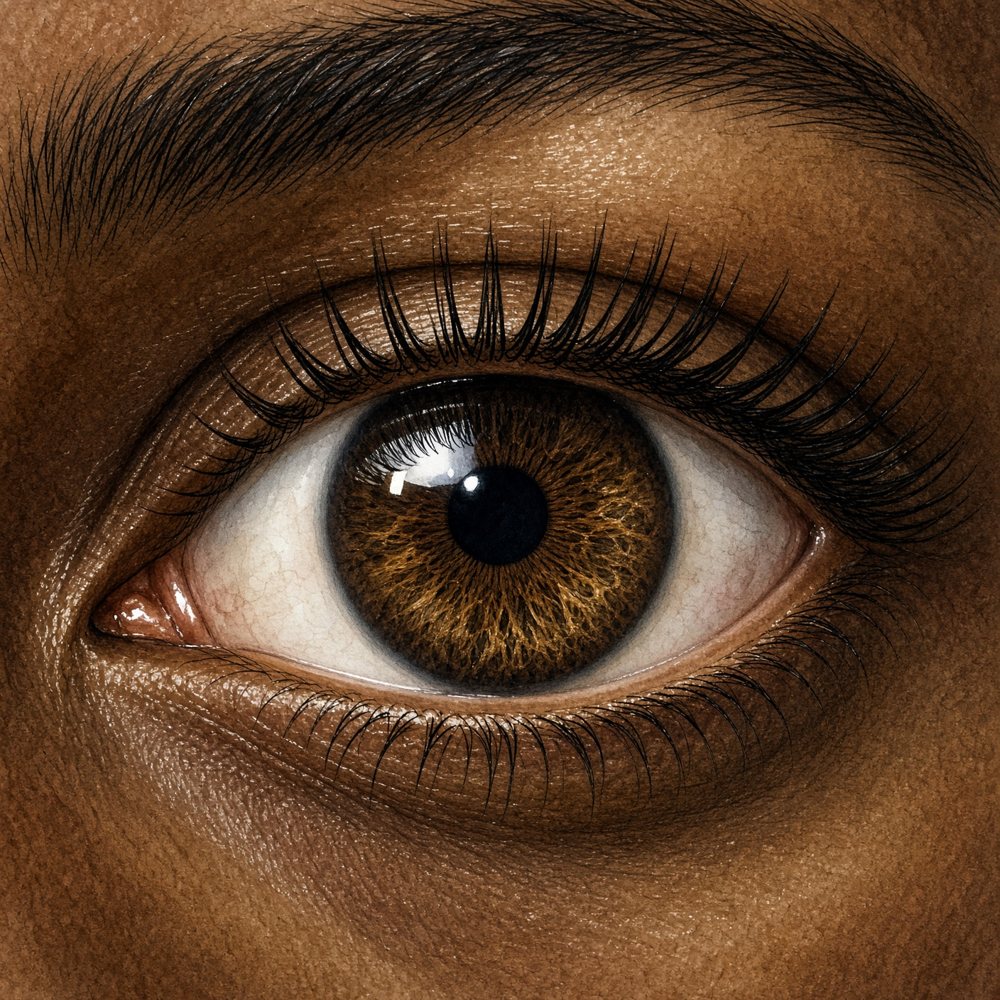
Close-up of a human eye showing a brown iris
…the human iris, the colored ring of the eye.
Lenses & Focal Points

Positive Lenses & Focal Points

  • A lens that converges light to a point is a positive lens. By convention its focal point is placed to its right.
  • Example: a lens that converges collimated light to a point 25 cm away is a +4.00 D lens, because 1/0.25 m = 4 D.
P=1f (m)P = \frac{1}{f\,(\text{m})}P=f(m)1​
Optical bench: light passing through a thin lens−40−30−20−100+10+20+30+40cm+4.00 DF′Ff = 25.0 cm
Incoming U0.00collimated
Lens P+4.00diopters
Outgoing V+4.00converging
Focal length+25.0 cmf = 1/P
U+P=V  ⇒  (0.00)+(+4.00)=+4.00 DU + P = V \;\Rightarrow\; (0.00) + (+4.00) = +4.00\,\text{D}U+P=V⇒(0.00)+(+4.00)=+4.00D
A plus lens converges collimated light to a real focal point F′ on its right, at f=1/Pf = 1/Pf=1/P. A +4.00 D lens focuses at 25 cm.
Lenses & Focal Points

Negative Lenses & Focal Points

  • A lens that diverges light is a negative lens. By convention its focal point is placed to its left.
  • Instead of a real focus, a negative lens makes collimated light appear to diverge from a point a certain distance in front of the lens.
  • Example: if the light seems to come from 25 cm before the lens, it is a −4.00 D lens, because 1/−0.25 m = −4 D.
Optical bench: light passing through a thin lens−40−30−20−100+10+20+30+40cm−4.00 DF′ (virtual)Ff = 25.0 cm
Incoming U0.00collimated
Lens P-4.00diopters
Outgoing V-4.00diverging
Focal length−25.0 cmf = 1/P
U+P=V  ⇒  (0.00)+(−4.00)=−4.00 DU + P = V \;\Rightarrow\; (0.00) + (-4.00) = -4.00\,\text{D}U+P=V⇒(0.00)+(−4.00)=−4.00D
A minus lens diverges collimated light. Trace the rays backward (dashed) and they seem to come from a virtual focal point F′ on the lens's left. A −4.00 D lens makes light seem to come from 25 cm in front of it.
Lenses & Focal Points

Two Focal Points: Positive Lenses

  • Every lens has two focal points. For a positive lens, the one on the right is where collimated light focuses.
  • The one in front (left) is where a light source produces collimated light beyond the lens.
  • Example: a light at the front focal point of a +5.00 D lens (20 cm away) reaches the lens with 1/−0.20 m = −5 D of divergence.
  • The lens adds +5 D, producing zero vergence: collimated light.
V=U+P=(−5)+(+5)=0 DV = U + P = (-5) + (+5) = 0\ \text{D}V=U+P=(−5)+(+5)=0 D
Optical bench: light passing through a thin lens−40−30−20−100+10+20+30+40cm+5.00 DF′Ff = 20.0 cm
Incoming U-5.00diopters
Lens P+5.00diopters
Outgoing V0.00collimated
Focal length+20.0 cmf = 1/P
U+P=V  ⇒  (−5.00)+(+5.00)=0.00 DU + P = V \;\Rightarrow\; (-5.00) + (+5.00) = 0.00\,\text{D}U+P=V⇒(−5.00)+(+5.00)=0.00D
Put a point source at the front focal point F of a plus lens. The light arrives with vergence U=−PU = -PU=−P, and the lens adds exactly +P+P+P, so it leaves collimated.
Lenses & Focal Points

Two Focal Points: Negative Lenses

  • For a negative lens, the focal point on the left is the imaginary point from which collimated light appears to emanate.
  • The one on the right is where, if converging light were heading toward it, the lens would cancel that convergence.
  • Example: +5.00 D of converging light reaching a −5.00 D lens emerges collimated.
  • That light would have focused 20 cm right of the lens, so that point is its right-hand focal point.
V=U+P=(+5)+(−5)=0 DV = U + P = (+5) + (-5) = 0\ \text{D}V=U+P=(+5)+(−5)=0 D
Optical bench: light passing through a thin lens−40−30−20−100+10+20+30+40cm−5.00 Dwhere +5 D light would focusF′ (virtual)Ff = 20.0 cm
Incoming U+5.00diopters
Lens P-5.00diopters
Outgoing V0.00collimated
Focal length−20.0 cmf = 1/P
U+P=V  ⇒  (+5.00)+(−5.00)=0.00 DU + P = V \;\Rightarrow\; (+5.00) + (-5.00) = 0.00\,\text{D}U+P=V⇒(+5.00)+(−5.00)=0.00D
Light converging toward a point 20 cm to the right (+5.00 D) meets a −5.00 D lens. The vergences cancel, so the light leaves collimated. That point is the minus lens's right-hand focal point.
Wrap-up

Key Ideas

VergenceV=1d (m)V = \frac{1}{d\,(\text{m})}V=d(m)1​− diverging, + converging
Optical infinity6 m=20 ft⇒V≈06\ \text{m} = 20\ \text{ft} \Rightarrow V \approx 06 m=20 ft⇒V≈0treated as collimated
Reflectionθi=θr\theta_i = \theta_rθi​=θr​measured from the normal
Snell’s Lawn1sin⁡θ1=n2sin⁡θ2n_1 \sin\theta_1 = n_2 \sin\theta_2n1​sinθ1​=n2​sinθ2​
Index of refractionn=cvn = \frac{c}{v}n=vc​
Lens powerP=1f (m)P = \frac{1}{f\,(\text{m})}P=f(m)1​
Vergence equationV=U+PV = U + PV=U+Pexiting = entering + power
Ready to practice?Open interactive worksheet Worksheet PDF